
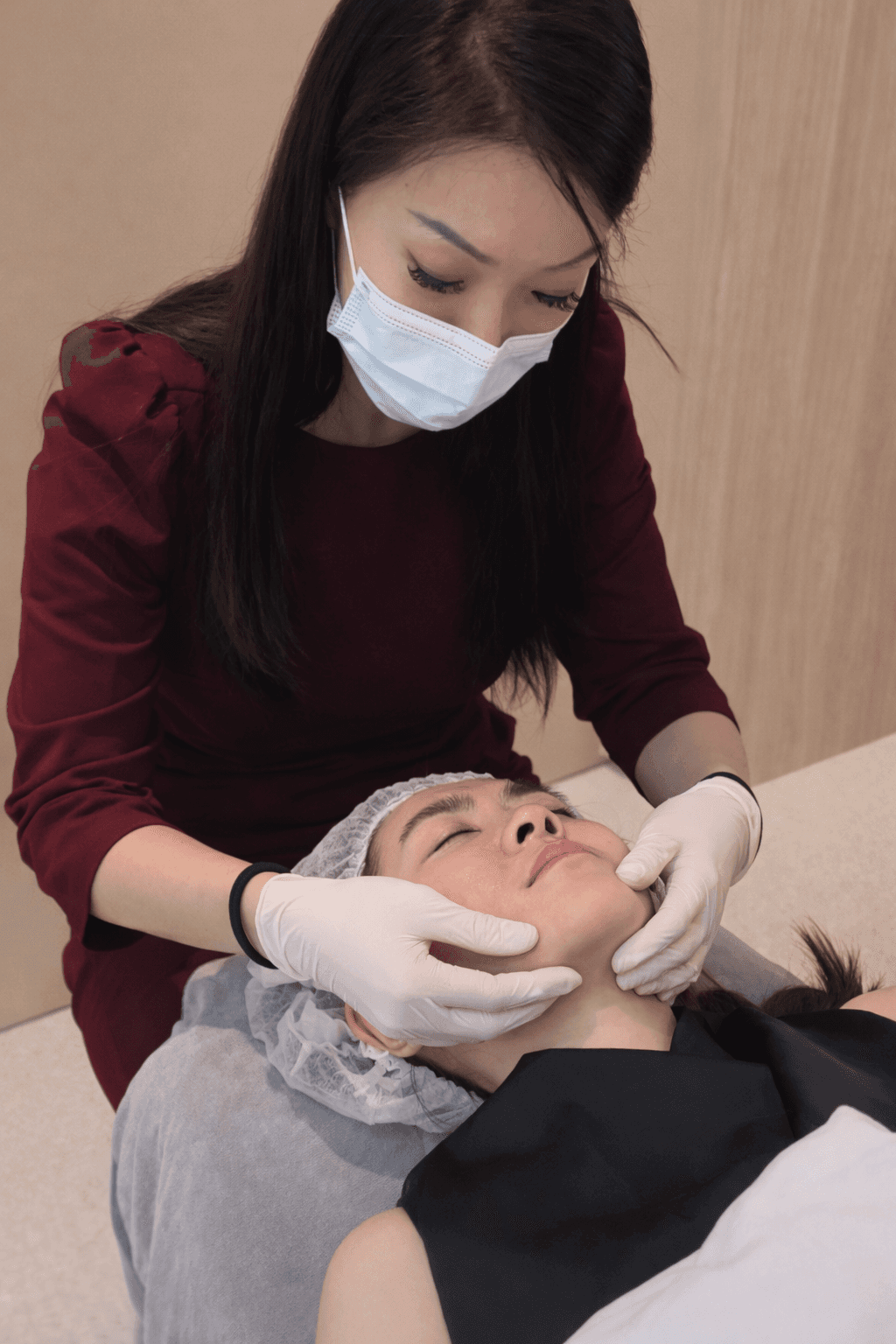
Chin Fillers in Singapore

There are times when your features look balanced from one angle, but not from another. Face front, everything looks fine. From the side, though, your chin may appear less projected, or your jawline less defined than you expect.
These are often structural, not surface-level, concerns. At Cambridge Medical Group (Somerset), Dr Shirley Kwee uses chin fillers to adjust projection and support in a way that aligns with your natural facial proportions.
How Chin Fillers Enhance Facial Structure
What does a chin filler contain, and how does it bring back balance and structure to your face? Here’s what you need to know.
What Chin Fillers Are Made Of
Chin fillers are typically made with hyaluronic acid (HA), a substance naturally found in your skin that helps retain moisture and maintain structure.
In aesthetic treatments, HA is formulated as a gel that retains its shape once placed, allowing it to support areas where definition has been reduced or where greater projection is needed.
Not all HA fillers are equally suited to the chin. Because this area is subject to constant movement and compression, the chin requires a filler with a high G-prime (meaning it is firm enough to resist pressure and hold its shape), high cohesiveness (meaning it stays localised rather than spreading), and a high degree of cross-linking (which determines how long it remains intact in the tissue). These three properties together make a filler appropriate for structural work in the lower face.
Because hyaluronic acid is already present in the body, it is gradually broken down over time. If you are unhappy with the result, HA-based chin fillers can be dissolved with an enzyme called hyaluronidase, which breaks them down safely. This reversibility is one reason why first-time patients are usually advised to start with an HA filler before considering longer-lasting alternatives.
Collagen-Stimulating Fillers as an Alternative
For patients seeking longer-lasting results, collagen-stimulating fillers such as those containing calcium hydroxylapatite (CaHA) or polycaprolactone (PCL) may be discussed. Unlike HA fillers, these work by gradually stimulating your body's collagen production while also providing immediate volume. Results can last up to 18 to 24 months. The trade-off is that these fillers are not reversible in the same way and are generally recommended for patients who have already tried HA fillers and are satisfied with their outcomes. Dr Shirley Kwee will discuss which option is most appropriate for your goals and history during your consultation.
How Dermal Fillers Add Projection to the Chin
Chin fillers are placed at specific depths, often close to the bone, to reinforce the underlying structure of the lower face.
By building support at this spot, the chin can be reshaped in a controlled way. This influences how the lower face is framed, particularly how the chin transitions into the surrounding areas, and creates a more defined and structured appearance without adding unnecessary volume.
In many ways, the chin acts as a structural anchor for the lower face. When support is restored here, the surrounding areas can appear lifted and defined.
Concerns that Chin Fillers May Help Address
Sometimes the lower face just doesn’t look as defined as you expect it to. That can come down to the chin. Here’s what we mean.
Recessed or Weak Chin
A recessed chin sits further back in relation to the lips and nose, which can affect how the lower face appears in profile. It may also reduce the distinction between the chin and neck. This is particularly common among Asian patients, whose facial bone structure often results in a shorter or less projected chin compared to other ethnic groups.
Chin fillers can be used to bring the chin slightly forward, improving its alignment with the rest of your features while maintaining a natural appearance.
Short or Underdeveloped Chin
In some cases, the chin appears shorter vertically, which can make the lower third of the face look compressed. Facial aesthetics often follow the "golden ratio", where the face is ideally divided into three equal thirds, from the hairline to the brows, from the brows to the nose tip, and from the nose tip to the chin. When the lower third appears shorter or less projected, this balance is disrupted.
Filler can be used to extend the chin, helping create a more even distribution across the upper, middle, and lower portions of the face.
Chin Asymmetry
It’s rare for a chin to be perfectly symmetrical. One side may appear fuller, longer, or positioned slightly differently from the other.
Filler can be placed in targeted areas to even out these differences, allowing for a more balanced shape without altering the entire chin.
Cleft, Dimpled, or Textured Chin
Some patients have a naturally cleft or dimpled chin, or a surface that appears uneven or has an "orange peel" texture. Filler can be placed to smooth out these irregularities, creating a cleaner, more even chin surface without surgery.
Lack of Definition Along the Lower Face
When the chin lacks structure, the lower face can appear less defined overall. The outline of the chin may blend into the surrounding areas rather than forming a clear endpoint.
By refining the chin's shape, filler can sharpen this endpoint and create a clearer distinction in the lower face. Improving projection here may also reduce the appearance of a mild double chin, as a more forward-positioned chin lifts the surrounding area and improves the distinction between the chin and neck.
How Chin Fillers Can Improve Facial Proportions
Facial balance comes down to how your features relate to one another. The chin often acts as a reference point in the lower face, influencing how other features are perceived rather than drawing attention to itself.
Creating Better Balance Between Nose, Lips, and Chin
When the chin is out of proportion, it can shift how other features appear. A smaller chin, for example, may make the nose seem more prominent or the lips appear more forward.
Adjusting the shape and position of the chin can bring these features into better visual alignment, creating a more cohesive relationship across the face.
Supporting a More Defined Jawline
The chin influences how the jawline tapers and connects across the lower face. When it has a nice shape, it allows the jawline to read as a continuous line rather than a separate feature.
Refining the chin can improve this continuity, giving the lower face a more structured and intentional outline. For patients seeking more comprehensive lower-face definition, chin fillers are often combined with jawline fillers to shape and sharpen the entire lower facial frame. These can be performed in the same session.
Enhancing the Side Profile
The side profile brings together the forehead, nose, lips, and chin into a single line of view. Subtle adjustments to the chin can help even out this line, reducing abrupt transitions between features and creating a profile that appears more proportionate from the side.

Chin Filler Aesthetics: Men vs Women
The goals for chin filler treatment differ meaningfully between men and women, and treatment should be planned with these differences in mind.
For Men: The aim is generally to build a stronger, broader chin with more forward projection. A square, well-defined chin and jawline enhance masculine features and contribute to a more structured lower face. Men typically require a higher volume of filler, often 2 to 3ml, to achieve the desired breadth and projection. Chin fillers for men are frequently combined with jawline fillers to ensure the lower face reads as a cohesive unit.
For Women: The preference usually leans toward a more tapered, elongated chin that supports a V-shaped or oval facial profile. The goal is refinement rather than broadening, adding downward projection and subtle definition to create a slimmer-looking lower face. Women typically require 1 to 2ml of filler to achieve this outcome.
During your consultation, Dr Shirley Kwee will assess your facial proportions and discuss which approach aligns with your aesthetic goals.
Who May Consider Chin Filler Treatment?
Chin fillers are usually considered when you’re looking at your face as a whole and feel that something is slightly off, but not easily explained by one feature alone.
You may consider getting a chin filler if you:
Notice how your face looks different depending on the angle: it looks balanced from the front, but less defined or structured from the side.
Find yourself adjusting how you pose in photos, such as tilting your chin or avoiding certain angles to create a more defined look.
Feel that your lower face lacks structure compared to the rest of your features, even if your skin quality or weight has not changed.
You are looking for a way to refine facial proportions without surgery, with the flexibility to adjust results over time.
Who Should Avoid Chin Fillers?
Chin fillers are not suitable for patients who are pregnant or breastfeeding, have an active skin infection near the treatment area, have known allergies to hyaluronic acid or lidocaine, or have bleeding disorders that may increase the risk of bruising or complications.
A small adjustment can shift how your features come together.
Find out if chin filler is suitable for you at Cambridge Medical (Somerset) in Singapore.
What Happens During a Chin Filler Procedure?
A chin filler procedure is planned around your facial structure rather than a fixed template. Here’s what you can expect:
Before the Procedure
We review your medical history, including any medications or supplements you are currently taking. Blood-thinning medications and supplements such as fish oil, vitamin E, and ginkgo biloba should be avoided in the week before treatment to reduce the risk of bruising. Alcohol should also be avoided for at least 24 hours beforehand.
During the Procedure:
Assessment and planning: Dr Kwee evaluates your profile, proportions, and how your features sit together. Specific points on the chin may be marked to guide filler placement.
Targeted injections: Small amounts of filler are placed in targeted areas of the chin, often at deeper levels, depending on the structure required. The approach is gradual, building shape step by step rather than making large changes at once.
Comfort measures: A numbing cream or local anaesthetic may be used, especially when working closer to the bone. Patients describe the sensation as pressure or mild discomfort.
Shaping and refinement: After placement, the area may be gently adjusted to ensure the filler sits evenly and the contour looks balanced.
After the procedure:
You can usually return to your usual activities on the same day. The chin may feel slightly firm or tender for a short period as it settles.
To support recovery, you should:
Avoid strenuous exercise and alcohol for 24 to 48 hours.
Avoid touching or pressing the treated area for 48 hours.
Stay out of saunas and direct sun exposure for at least two weeks.
Avoid additional facial treatments or procedures in the area for at least two weeks.
Sleep with your head slightly elevated on the first night to help minimise swelling.
A "witch chin" deformity, an overly elongated or pointed chin, can develop if excessive amounts of filler are applied over multiple sessions without adequate review. Dr Shirley Kwee takes a conservative, graduated approach, assessing results at each stage and advising against over-treatment to ensure the outcome remains proportionate and natural.
Explore Chin Filler Treatment in Singapore
If you’ve been noticing subtle imbalances in your lower face but can’t quite pinpoint why, it may come down to how the chin is shaping your overall profile. Small structural adjustments here can change how your features come together, without altering how you look as a whole.
At Cambridge Medical (Somerset), chin filler treatment is approached with careful planning and restraint. Book a consultation with Dr Shirley Kwee to explore your options.
Frequently Asked Questions
What are the side effects of chin fillers?
You may experience mild swelling, tenderness, or bruising at the injection sites for a few days. More serious but rare complications include vascular occlusion, where filler inadvertently enters a blood vessel, which can cause tissue damage. At Cambridge Medical (Somerset), safety is prioritised through thorough anatomical knowledge, the use of blunt cannulas where appropriate, slow, precise injection techniques, and hyaluronidase on standby as an emergency measure.