

11 Jun 2026
Dermal Fillers in Singapore: What You Need to Know Before Treatment
Summary:
|
Dermal fillers are among the most widely used treatments in aesthetic medicine, yet they are also among the most frequently misunderstood. The mental image many people have tends towards dramatic results, rather than the subtle, structural work that characterises how fillers are most often used.
In practice, dermal fillers in Singapore are typically used to support and restore areas of the face that have gradually changed over time, not to dramatically alter appearance. This guide covers what fillers do, where they are used, what the treatment involves, and what to consider before proceeding.
What Are Dermal Fillers?
Dermal fillers are injectable treatments that use biocompatible materials to restore structure and volume to areas of the face that have lost volume. The materials used fall into two broad categories, each working differently within the skin.
Hyaluronic acid fillers work by attracting and retaining moisture within the skin, providing immediate volume to areas such as the lips, under-eyes, or smile lines. HA fillers are reversible if needed, which makes them a commonly considered option for first-time patients or for areas requiring a more conservative approach.
Bio-stimulators work more gradually, prompting the skin to produce its own collagen over time. Rather than adding immediate volume, they support structural improvement from within, and are often used in areas such as the cheeks or jawline where deeper, longer-term support is the goal.
How Dermal Fillers Work Beneath the Skin
As the face ages, hyaluronic acid diminishes, fat pads shift, and the underlying structures that give the face its shape gradually change. The result is often a combination of hollowness, softer facial contours, and deeper folds.
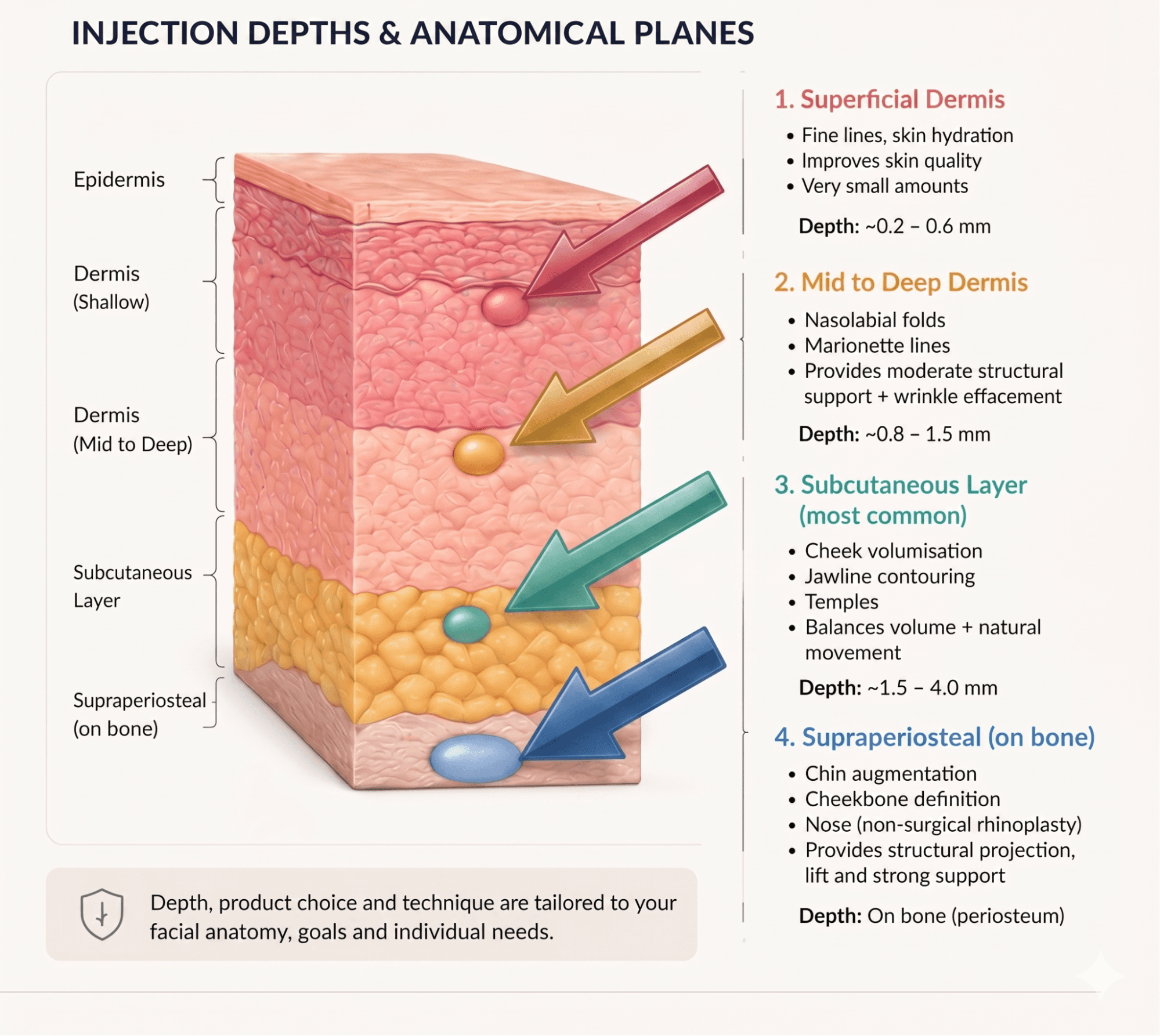
Dermal fillers are selected and placed to address these changes at the depth where they occur, rather than simply adding material beneath the skin.
For areas that require structural support, such as the cheeks or chin, firmer fillers are placed at greater depth, often near the bone, to restore the underlying foundation.
For high-movement areas such as smile lines, more flexible formulations are used so that the filler moves naturally with facial expressions.
For delicate areas such as the under-eyes or lips, softer fillers are placed closer to the skin’s surface to allow for subtle, controlled refinement.
The Facial Changes That Dermal Fillers Can Address
The changes that bring people to consider dermal fillers in Singapore tend to develop gradually and often affect more than one area at a time. The table below outlines the most common treatment areas, how the concern typically presents, and the general approach used.
Area | How It Presents | What the Concern Reflects | Filler Placement | Filler Type Typically Used |
Under-eyes (tear trough) 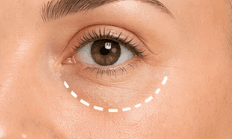 | Hollow or shadowed appearance beneath the eyes, giving a tired look even when well-rested | Loss of volume and support in the periorbital area | Superficial; close to the skin surface | Soft HA filler |
Cheeks 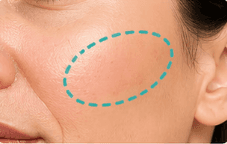 | Flatter or less lifted appearance; the mid-face looks less supported overall | Loss of fat volume and structural support in the mid-face | Deep, near bone for lift and projection | Firmer HA filler or bio-stimulator |
Nasolabial folds 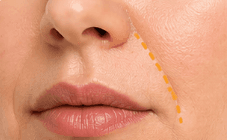 | Lines running from the nose to the corners of the mouth remain visible at rest | Often reflects volume loss in the cheeks above rather than an isolated fold | Mid-depth; flexible placement | Flexible HA filler |
Marionette lines  | Lines pulling slightly downward from the corners of the mouth, giving a heavier expression | Loss of support in the lower face and corners of the mouth | Mid-depth | Flexible HA filler |
Jawline 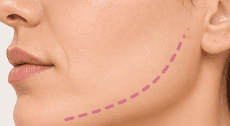 | Softer or less defined jaw edge; reduced clarity between the face and neck | Loss of structural definition along the mandibular border | Deep, along the jawline | Firmer HA filler or bio-stimulator |
Chin 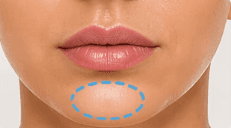 | Chin appears less defined or slightly recessed, affecting lower face balance | Reduced chin projection or definition over time | Deep, near bone | Firmer HA filler |
Lips 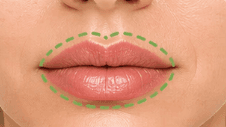 | Changes in lip border definition or subtle loss of structure, rather than simply volume loss | Gradual reduction in lip architecture and vermilion border clarity | Superficial to mid-depth | Soft HA filler |
These areas are interconnected. When one part of the face shifts, it can affect how other areas appear. A thorough assessment looks at the face as a whole rather than treating each concern in isolation.
Are Dermal Fillers Safe?
Dermal fillers are generally well-tolerated when administered by a qualified doctor using approved products. Most filler materials are biocompatible, meaning the body gradually metabolises them over time.
After treatment, some swelling, redness, or bruising at the injection sites is common and typically resolves within a few days. Serious complications are uncommon but are always assessed and planned for as part of a responsible treatment approach.
The appearance of results is also part of the safety consideration. Outcomes that appear uneven or disproportionate usually reflect treatment planning rather than the filler itself. The type of filler, depth of placement, and amount used all influence how natural and proportionate the results will be.
At Cambridge Medical (Somerset), filler selection, placement depth, and volume are all determined by the individual’s anatomy and goals, with the aim of supporting natural movement and proportions rather than altering them.
Book a consultation with us to receive a treatment plan tailored to you for dermal fillers in Singapore.
What to Expect at a Dermal Filler Appointment in Singapore
Understanding what a filler session involves can help set realistic expectations before you attend.
Initial assessment. At your first visit, your doctor will assess how your facial features work together, considering volume, structural support, and proportion. This is also an opportunity to discuss any changes you have noticed and what you would like to address.
Treatment planning. If dermal fillers are appropriate for your concerns, treatment can typically be scheduled at the same visit or shortly after.
During the procedure. Most fillers contain a local anaesthetic, so discomfort is generally mild. You may feel some pressure or a brief sting at the injection points. Filler is placed gradually to allow for careful assessment throughout the session, which typically takes 15 to 30 minutes, depending on the areas treated.
Immediately after. Some areas may appear slightly fuller initially due to swelling. Final results are assessed once swelling has settled, typically within a few days. Your doctor will advise on what to avoid in the period immediately following treatment.
Recovery. Most patients are able to resume normal activities shortly after treatment.
How Long Do Results From Dermal Fillers Last?
Dermal fillers are not permanent. How long results last depends on the formulation used, the area treated, and how an individual’s body metabolises the material. Areas with more movement, such as the lips, tend to break down filler more quickly than areas that are relatively static, such as the cheeks or chin.
Treatment Area | Typical Duration | Why Results May Not Last as Long | Maintenance Approach |
Lips | 6 to 9 months | High movement area; filler metabolised more quickly | Follow-up treatment typically considered after 6 months |
Nasolabial folds / Marionette lines | 9 to 12 months | Moderate movement; area subject to daily facial expression | Follow-up at 9 to 12 months, depending on individual response |
Under-eyes (tear trough) | 12 months or more | Low-movement area; soft filler is used, which integrates gradually | Maintenance as needed based on how results settle |
Cheeks | 12 to 18 months | Relatively static area; firmer filler placed at depth | Follow-up at 12 to 18 months; bio-stimulators may extend this |
Jawline / Chin | 12 to 18 months | Low-movement area; firmer filler placed deeply | Follow-up at 12 to 18 months, depending on individual response |
These are general ranges. Individual results vary based on metabolism, lifestyle, and the specific products used. Your doctor will advise on an appropriate maintenance schedule based on how your results develop over time.
Considering Dermal Fillers in Singapore? Start with a Personalised Consultation
Dermal fillers should be tailored to your facial anatomy and goals rather than applied as a standard treatment. At Cambridge Medical (Somerset), a full assessment of your features precedes any treatment recommendation, with the aim of selecting the appropriate filler type, placement, and volume for your individual needs.
Book a consultation today so our doctors can advise you on your dermal fillers treatment plan.